

Table of Contents
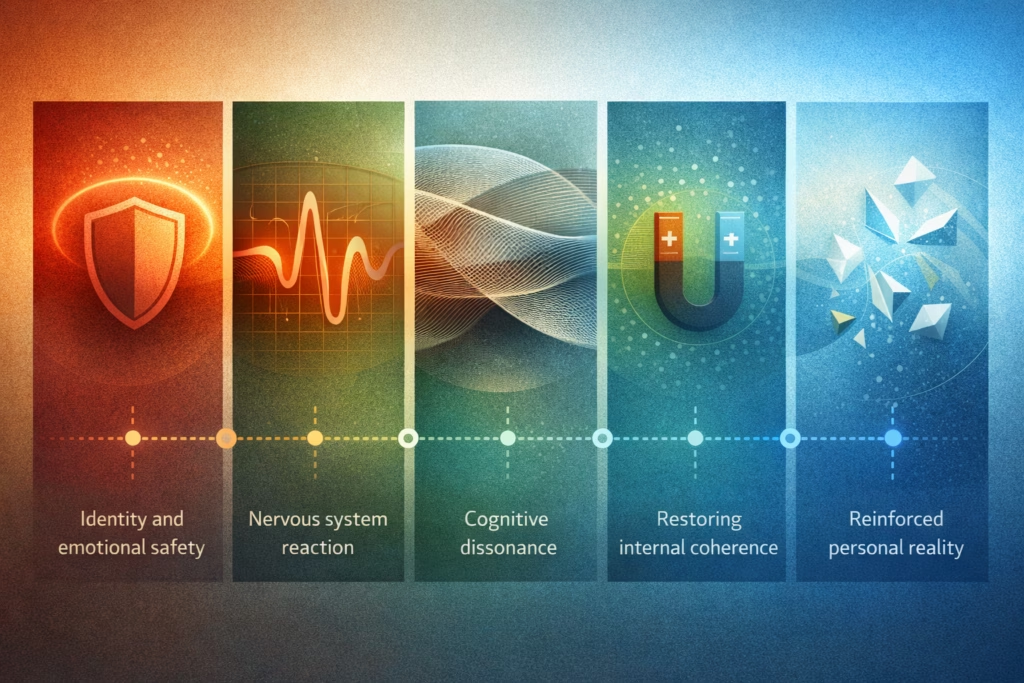
- Identity and emotional safety get activated.
- Your nervous system reacts before logic catches up.
- Cognitive dissonance creates real discomfort.
- Defending beliefs restores “internal coherence” fast.
- Personal reality feels reinforced by what you notice and remember.
Confirmation bias does not only shape what you believe, it shapes what feels safe to believe within a particular context. When a belief becomes tied to identity or emotional safety, disagreement can register as threat rather than information, which means the system organizes toward protection before it organizes toward evaluation. This post clarifies five reasons challenges can feel painful or personal, even when you intend to stay open-minded, because coherence and safety often guide interpretation before conscious choice becomes available.
1. Identity and Emotional Safety Get Activated
When beliefs connect to identity or emotional safety, disagreement can feel threatening rather than informative because the challenge can be received as a statement about you rather than about an idea. This reveals a principle of alignment: when a viewpoint becomes coupled with worth or belonging, the system treats contradiction as relational risk, therefore attention shifts from understanding to self-protection.
Example: If you strongly identify with a viewpoint, a simple “I see it differently” can feel like rejection.
Practical application: Before responding, separate who you are from what you believe by asking, “Is this about my worth—or just a claim I’m evaluating?”
2. Your Nervous System Reacts Before Logic Catches Up
The nervous system may react before logical reasoning engages, which can make contradiction feel painful or personal because the body can interpret disagreement as danger. As a result, the mind can rush to produce a coherent explanation that matches the intensity, which means urgency can resemble certainty even when it reflects activation rather than evidence.
Example: You feel heat, tension, or urgency mid-conversation, then you suddenly “need” to win the point.
Practical application: Treat the first wave as a body signal, not a final verdict—pause, breathe, and let the initial reaction settle before you decide what you think.
3. Cognitive Dissonance Creates Real Discomfort
Cognitive dissonance is the discomfort that shows up when new information collides with an existing belief, and the discomfort can become the immediate problem the system tries to resolve. Because that tension is unpleasant, people often restore stability by defending what they already believe rather than revising it, therefore relief can arrive faster than understanding.
Example: You encounter a contradiction and immediately start searching for flaws in it—not to learn, but to relieve tension.
Practical application: Name the feeling (“This is dissonance”) and allow yourself to hold uncertainty for a moment without forcing a quick conclusion.
4. Defending Beliefs Restores “Internal Coherence” Fast
In threatening moments, internal coherence, meaning the feeling of being consistent inside, is often prioritized over objective accuracy because coherence restores stability quickly. This clarifies a system-level pattern: when stability is under pressure, defending the current belief can feel like the shortest path back to internal order, which means updating can be experienced as destabilizing even when you value truth.
Example: You double down on your original interpretation because it feels cleaner than admitting a messy “maybe.”
Practical application: Replace “I must be right” with “I can stay coherent while updating”—then look for one small detail you could revise without flipping your entire worldview.
5. Personal Reality Feels Reinforced by What You Notice and Remember
Confirmation bias pushes you to favor information that supports existing beliefs while filtering out contradictions, and this operates through what you notice, how you interpret it, and what you remember. Over time, confirming details can become more salient, conflicting evidence can fade, and the belief can feel like simple reality rather than a maintained interpretation, therefore certainty can feel like the environment instead of a conclusion you reached.
Example: After an argument, you remember every detail that supports your side and forget the parts that complicate it.
Practical application: Do a quick balance check: write one piece of evidence that supports your belief and one that challenges it—then ask what you’d conclude if you had to explain both fairly.
When being challenged feels threatening, it is often because your mind and body are protecting identity, emotional safety, and internal coherence, not because the new information is automatically wrong. Confirmation bias can make personal reality feel self-evident by shaping what you notice, how you interpret it, and what you remember, which means discomfort can signal a protective demand for coherence rather than proof. The goal is not to erase discomfort, it is to recognize it early enough to choose an intentional response, so you can stay coherent while updating rather than treating uncertainty as danger.