
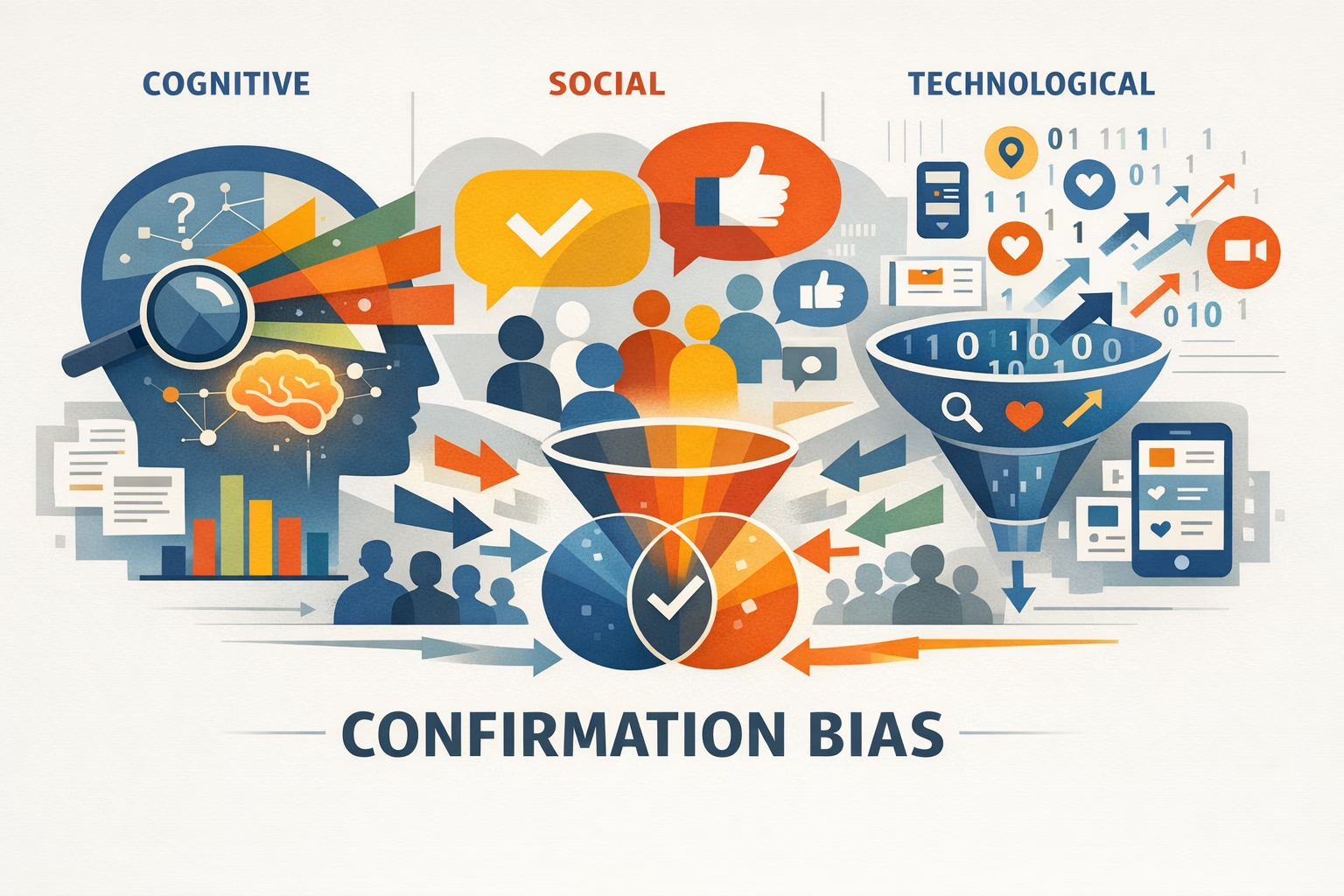
Confirmation bias describes a cognitive tendency in which the mind preferentially selects information that supports existing beliefs while filtering information that contradicts those beliefs. Conscious awareness processes only a small fraction of the information available to the brain. Consequently, belief structures function as perceptual filters that determine which signals appear relevant, credible, and meaningful within an interpreted environment.
- Definition and perceptual filtering mechanisms associated with confirmation bias.
- Cognitive and physiological conditions associated with belief challenge responses.
- Domains in which confirmation bias appears in everyday interpretive contexts.
- Algorithmic reinforcement of confirmation bias within technology and artificial intelligence systems.
Confirmation bias operates through cognitive mechanisms that influence attention, interpretation, and memory processes. Less than one percent of processed information typically reaches conscious awareness; therefore, perceptual systems rely on expectation, prior experience, and emotional relevance during information selection. Repeated exposure to belief-consistent information gradually strengthens interpretive frameworks and stabilizes perceived reality. In addition, technology and artificial intelligence systems frequently reinforce these patterns through engagement-based filtering and recommendation processes. Analytical examination of these dynamics clarifies how belief structures influence interpretation prior to deliberate reasoning.

Structural Mechanisms Through Which Confirmation Bias Constructs Interpreted Personal Reality
The following sections analyze the formation of confirmation bias, the defensive response frequently associated with belief challenges, the presence of the bias across everyday interpretive domains, and the amplification of these mechanisms within digital systems. Each section examines how belief structures influence interpretation of information and contribute to the construction of perceived reality.
Definition and Perceptual Filtering Mechanisms of Confirmation Bias
Confirmation bias refers to the cognitive tendency to seek, interpret, and remember information that supports established beliefs. The brain processes extensive volumes of sensory and cognitive input during each moment; however, less than one percent of that information typically reaches conscious awareness. Efficient perception therefore requires filtering mechanisms based on expectation, prior experience, and emotional relevance. Once a belief framework forms, confirming information becomes more cognitively salient, whereas contradictory information receives reduced emphasis during attention and recall. The resulting process forms a reinforcing interpretive loop in which belief structures guide perception and perception strengthens the underlying belief framework.
Five Cognitive and Physiological Mechanisms Associated With Defensive Responses to Belief Challenges
Belief structures frequently connect with identity organization, emotional stability, and perceived understanding of surrounding environments. When contradictory information appears, the experience may be interpreted as a disruption to interpretive coherence rather than as neutral evidence. Physiological and cognitive reactions may therefore occur before reflective reasoning evaluates the information.
- Identity association: A belief may integrate with personal identity structures and social affiliation frameworks.
- Emotional stability maintenance: A stable belief framework contributes to psychological predictability and perceived environmental order.
- Nervous system activation: Disagreement can activate stress responses before analytical evaluation processes occur.
- Cognitive dissonance: Incompatible information generates psychological discomfort when established interpretations encounter contradiction.
- Internal coherence preservation: Cognitive systems frequently prioritize maintenance of a consistent interpretive structure.
These mechanisms illustrate how belief defense functions as a cognitive process that maintains interpretive coherence within perception and evaluation.
Identification of Confirmation Bias Across Relationship, Health, Workplace, and Digital Information Contexts
Confirmation bias appears across multiple domains of everyday interpretation and decision processes. Expectations influence which observations receive attention, while memory processes reinforce early interpretations through selective recall mechanisms.
- Relationships: Expectations influence interpretation of interpersonal behavior and determine which interactions remain salient in memory.
- Health decisions: Initial impressions regarding symptoms or treatments influence evaluation of subsequent evidence.
- Workplace interpretation: Early judgments regarding competence or reliability guide interpretation of later performance information.
- Online environments: Digital platforms frequently deliver content aligned with prior preferences, producing reinforcing informational exposure patterns.
Recognition of these patterns supports structured evaluation of information across several domains of everyday experience.
Algorithmic Reinforcement of Confirmation Bias in Technology and Artificial Intelligence Systems
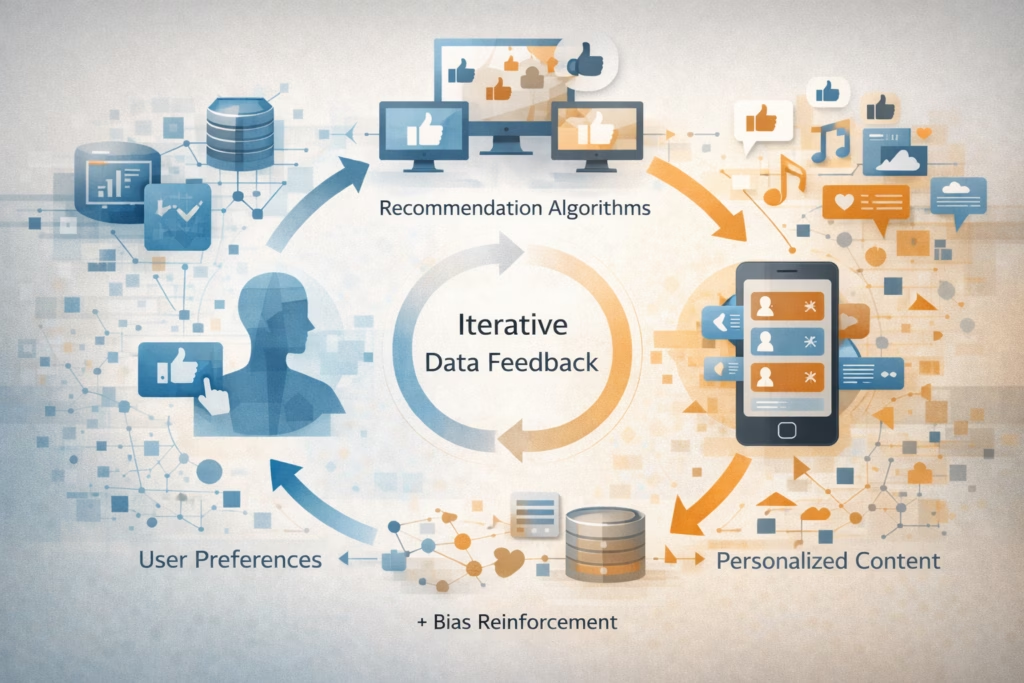
Digital technology frequently operationalizes confirmation bias through systems that analyze historical interaction patterns and engagement signals. Recommendation algorithms learn user preferences and repeatedly present similar categories of information, gradually narrowing informational exposure. Artificial intelligence systems may also reflect assumptions contained within training data and optimization objectives. When digital systems repeatedly mirror prior behavioral patterns, the resulting informational environment may appear neutral even though earlier interaction patterns influence the output. Through this mechanism, technological infrastructures can reinforce existing interpretive frameworks while reducing exposure to alternative perspectives.
FAQs
Confirmation bias refers to the tendency to favor information that supports existing beliefs while disregarding contradictory evidence.
Confirmation bias filters attention and interpretation so that confirming details receive greater cognitive emphasis while conflicting information receives reduced emphasis.
Challenges to belief frameworks can activate defensive responses when identity structures or perceived psychological stability become involved.
Less than one percent of processed information typically reaches conscious awareness.
Engagement-based systems frequently amplify content aligned with existing user preferences.
Analytical Recognition of Cognitive Filtering Mechanisms in Belief-Based Perception
Recognition of confirmation bias clarifies how belief frameworks influence attention, interpretation, and memory before deliberate reasoning occurs. Analytical awareness of these mechanisms supports more systematic evaluation of evidence and interpretation of information.
Examine interpretive assumptions during evaluation of new information in order to identify the influence of belief structures on perception and decision processes.