

Institute for Justice Overview: Mission, Legal Focus, Case Strategy, and Scale
The Institute for Justice occupies a specialized position within United States constitutional litigation. Public materials define a nonprofit public interest law firm oriented toward litigation against government overreach, constitutional enforcement, and precedent production. Core institutional presentation combines free representation, doctrinal selectivity, research publication, legislative support, and national operational reach.
Analytical relevance emerges from the interaction of mission claims, issue concentration, litigation scale, and financial depth. Public reporting attributes Supreme Court participation, legislative reform support, wrongful asset recovery, and eminent domain intervention to the organizational model. A useful examination therefore requires integrated review of mission structure, constitutional portfolio, case-selection mechanism, and publicly available financial data.
In this article
- Institute for Justice Mission Structure and Institutional Identity
- Institute for Justice Constitutional Portfolio and Issue Concentration
- Institute for Justice Case Selection and Precedent Mechanism
- Institute for Justice Financial Capacity and Operational Scale
Public content presents a selective constitutional litigation institution rather than a general legal-aid provider. Organizational emphasis falls on cases with broader constitutional significance, policy relevance, and rule-shaping capacity across courts and jurisdictions. That distinction governs accurate classification because institutional value rests less on broad service volume and more on strategic doctrinal intervention.
Reported outcomes reinforce that interpretation. Public claims include 13 arguments before the U.S. Supreme Court, 11 victories in that forum, $21 million in wrongfully seized assets returned, support for more than 300 legislative reforms, and protection of 20,000 homes and businesses from eminent domain abuse. Those figures position the Institute for Justice as a visible constitutional litigation nonprofit with substantial institutional ambition and measurable public-facing impact claims.

Institute for Justice Analytical Framework
Institutional evaluation benefits from four analytical categories. Mission structure establishes organizational identity. Constitutional portfolio clarifies doctrinal boundaries. Case-selection mechanics explain litigation strategy. Financial capacity reveals operational durability. Combined examination produces a more precise account than mission language or financial scale alone.
Institute for Justice Mission Structure and Institutional Identity
The Institute for Justice describes a nonprofit public interest law firm focused on constitutional litigation against government overreach. Public-facing language emphasizes constitutional rights, free representation, and nationwide activity through litigation, research, legislation, and activism. This structure signals a blended advocacy institution rather than a purely courtroom-centered practice.
Founding chronology begins in 1991, with organizational history describing expansion from a five-person startup into a nationally recognized law firm. Public nonprofit profiles place headquarters in Arlington, Virginia, and organizational materials state office presence in six states. More than 70 full-time attorneys indicate substantial legal staffing for a mission-driven nonprofit structure.
Institutional identity depends on selective constitutional orientation. General legal-service classification lacks fit with the organizational presentation because public materials emphasize broader constitutional implications rather than routine dispute resolution. A mission-driven litigation shop therefore offers the more accurate analytical category, especially in light of repeated emphasis on targeted doctrine, national litigation, and systemic legal change.
Search-intent alignment also supports that classification. Common informational demand concerns nonprofit status, constitutional focus, litigation record, financial scale, and organizational structure. Site navigation mirrors that demand through prominent placement of mission pages, issue categories, case intake explanations, staff materials, history, and financial reports. Explanatory architecture thus reflects a deliberate effort to frame the Institute for Justice as a specialized constitutional institution rather than a general civil-liberties umbrella organization.
Institute for Justice Constitutional Portfolio and Issue Concentration
The Institute for Justice organizes visible activity around a defined set of constitutional themes. Main categories include private property, First Amendment, educational choice, and economic liberty. Additional named projects include the End Forfeiture Initiative, the Project on Immunity and Accountability, the Project on the Fourth Amendment, the Food Freedom Initiative, and the Zoning Justice Project. Portfolio structure therefore reflects doctrinal concentration, categorical discipline, and recurring issue specialization.
Private property work includes eminent domain disputes and seizure controversies. Economic liberty work often concerns occupational licensing barriers and market-entry restrictions affecting small-business formation. First Amendment work covers speech disputes and retaliation claims. Educational choice work addresses school-choice programs and related constitutional questions. Additional project branding around forfeiture, zoning, accountability, and search-and-seizure doctrine deepens the constitutional map without dissolving portfolio coherence.
Issue concentration carries institutional consequences. Repetition across related doctrines creates stronger public legibility for courts, donors, journalists, and policymakers. Specialization also supports accumulation of legal expertise, narrative consistency, and internal efficiency in research and litigation development. A narrow doctrinal portfolio usually improves strategic clarity because each case can reinforce a larger body of constitutional argument rather than stand as an isolated dispute.
Legislative support adds a second layer to the portfolio model. Public materials state support for more than 300 legislative reforms, suggesting that courtroom activity functions alongside statutory advocacy and policy-oriented public communication. Research production and issue-specific projects then operate as amplification mechanisms, converting litigation into broader legal and political influence. The resulting structure resembles a strategic constitutional portfolio designed for doctrinal repetition, narrative discipline, and cross-channel reinforcement.
Institute for Justice Case Selection and Precedent Mechanism
Case intake follows a selective submission-and-review process. Public materials state that matters enter through an online form and receive legal-team review, with a six-to-eight-week response window when factual fit appears possible. Additional language indicates submission volume beyond response capacity. Intake design therefore reflects scarcity, filtration, and mission alignment rather than routine representation of all qualifying legal grievances.
That intake model corresponds with a precedent-oriented litigation philosophy. Homepage language describes “cutting-edge constitutional cases” intended both to defend rights and to establish rules protecting a wider field of similarly situated parties. Strategic litigation of that kind depends on careful fact-pattern selection, doctrinal leverage, appellate potential, and capacity for broader legal consequence. Lawsuits function not merely as dispute-resolution vehicles but as instruments for constitutional clarification and systemic rule formation.
A common public-interest mechanism appears in this structure: limited case inventory, high doctrinal leverage, and reinforcement through research, communications, and legislative follow-through. Each filing then serves multiple purposes at once. Immediate relief remains one objective, but doctrinal development, public explanation, and policy spillover remain equally central. Institutional selectivity therefore operates as a design choice necessary for precedent production and national-scale issue advocacy.
Performance claims within public materials reinforce the strategic model. The organization states that representation occurs free of charge and that nearly three out of every four filed cases result in victory. Additional public claims include 13 Supreme Court arguments, 11 victories in that forum, $21 million in wrongfully seized assets returned, and preservation of 20,000 homes and businesses from eminent domain abuse. Those metrics do not exhaust legal significance, but they do indicate a strong institutional preference for measurable constitutional outcomes and publicly legible impact indicators.
Recent annual reporting suggests substantial litigation volume. Fiscal year 2024 materials describe the period as only part of the biggest and busiest year yet, with the docket on track to exceed 110 active lawsuits in state and federal courts. Two Supreme Court victories during the broader period add evidence of appellate capacity and national doctrinal ambition. Combined with selective intake, such volume indicates a large and highly structured constitutional docket rather than occasional impact litigation.
Institute for Justice Financial Capacity and Operational Scale
Publicly available nonprofit data portray the Institute for Justice as a financially substantial national advocacy institution. Charity Navigator lists a 501(c)(3) organization headquartered in Arlington, Virginia and assigns a 100 percent score with a Four-Star rating. Audited financial statements and nonprofit profiles further indicate significant revenue, major reserve depth, and multistate operating capacity. Institutional scale therefore extends far beyond boutique-litigation dimensions.
According to 2025 audited financial statements, total support and revenue for the year ended June 30, 2025 reached about $47.6 million. Total expenses reached about $47.7 million, with program services accounting for about $38.8 million. The same filing reports about $143.5 million in total investments and about $178.0 million in total liabilities and net assets. Such figures indicate a durable capital base relative to annual operating expenditure.
Operational implications follow directly from that scale. Nationwide constitutional litigation requires expensive infrastructure, including multistate office administration, appellate practice, communications, publications, legislative engagement, case development, and long-duration court proceedings. More than 70 full-time attorneys across six states confirm organizational capacity for simultaneous work across multiple constitutional domains. Financial depth and staffing breadth together support a high-volume, precedent-oriented advocacy model.
Financial size alone does not establish mission success or legal merit. Effectiveness still depends on docket quality, doctrinal influence, transparency, and the relationship between mission claims and observable outcomes. Nevertheless, the public record indicates substantial alignment between organizational self-description and material capacity. A sound analytical method therefore compares three dimensions simultaneously: mission architecture on the organizational site, litigation claims and annual-report data, and independent nonprofit-finance records showing institutional durability and operational reach.
FAQs
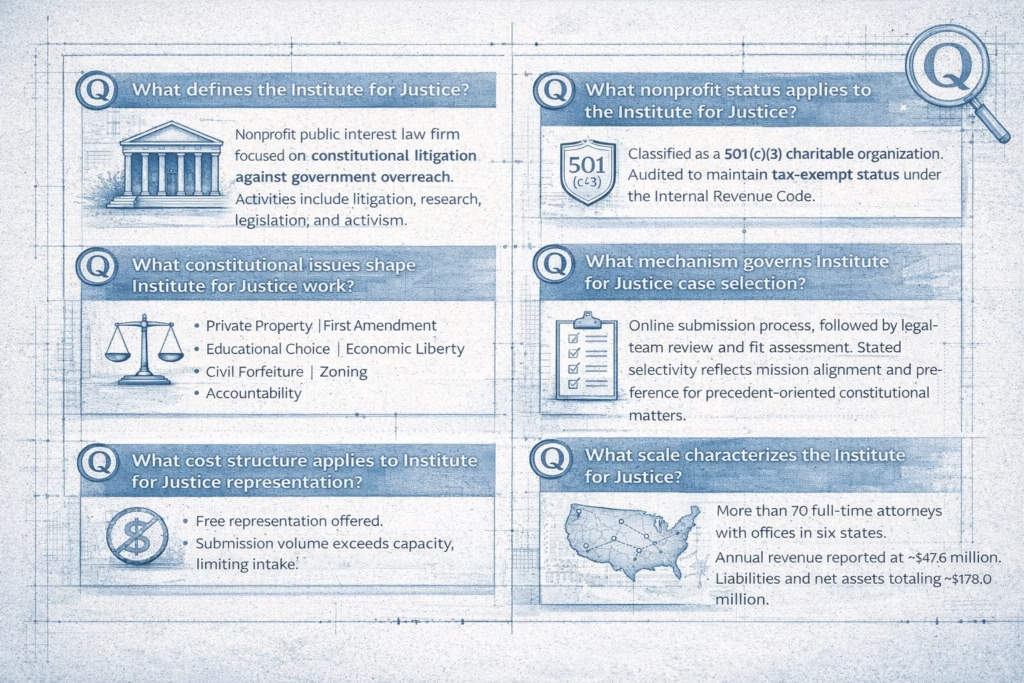
The Institute for Justice is a U.S. nonprofit public interest law firm focused on constitutional litigation against government overreach. Public materials emphasize litigation, research, legislation, and activism within a selective mission framework.
Public nonprofit records identify a 501(c)(3) charitable organization headquartered in Arlington, Virginia. Audited statements also classify the organization as tax-exempt under section 501(c)(3) of the Internal Revenue Code.
Primary categories include private property, First Amendment, educational choice, economic liberty, civil forfeiture, zoning, accountability, and Fourth Amendment disputes. Named projects indicate doctrinal specialization rather than broad undifferentiated legal coverage.
Public materials describe an online submission process followed by legal-team review and fit assessment. Stated selectivity reflects mission alignment, limited capacity, and preference for precedent-oriented constitutional matters.
Public materials state that representation occurs free of charge. Intake limits remain significant because submission volume exceeds organizational response capacity.
Organizational materials state more than 70 full-time attorneys and offices in six states. Audited 2025 financial statements report about $47.6 million in annual revenue and about $178.0 million in total liabilities and net assets, indicating a large national litigation nonprofit.
Institute for Justice Structural Assessment
Compare mission materials, annual reports, case records, and audited financial statements for direct evaluation of Institute for Justice constitutional priorities, litigation model, and institutional scale.
More on Institute for Justice
Explore Institute for Justice from every angle: