

Self-Coherence and the Psychology of Entrainment
Entrainment describes the tendency of interacting systems to move toward a shared rhythm. In psychology, the idea offers a useful way to examine how attention, emotion, belief, and behavior become coordinated through repeated contact. Self-coherence gives that process an internal reference point: a clear enough sense of identity to receive influence, evaluate it, and respond deliberately.
The image of a strong field pulling a weaker field into alignment captures an important intuition about human interaction. Organized patterns often shape disorganized ones. A person whose values, language, boundaries, and actions consistently reinforce one another can stabilize a conversation, relationship, or group. Incoming pressure is processed through that established pattern, allowing time before any new belief or behavior forms.
This article explains the science behind entrainment, translates transmutation into a practical psychological process, outlines ways to stay authentic under social pressure, and identifies habits that strengthen self-coherence. The central question is how to remain open to connection and learning while retaining independent judgment.
In this article
- Understanding the Principle of Entrainment
- Beginner’s Guide to Transmutation
- How-To Stay Authentic
- Top Five Ways to Build Self-Coherence

Understanding the Principle of Entrainment
In physics and biology, entrainment occurs when interacting oscillators adjust their timing and become phase-locked. Huygens’s pendulum clocks synchronized through vibrations carried by a shared support. Circadian systems align internal rhythms with recurring environmental cues such as light. Across these examples, alignment emerges through coupling, feedback, and repetition. Its direction and stability depend on the properties of each system and the conditions connecting them.
Human interaction contains comparable forms of coordination. Conversation partners adjust speech rate and vocal patterns. People coordinate movement during joint activity, share attention, mirror expressions, and sometimes display aligned physiological or neural activity. Research treats these effects as distinct forms of interpersonal synchrony, with outcomes shaped by the task, relationship, and measurement method. Synchrony can support rapport, communication, cooperation, and group bonding.
The psychological version of a “strong field” is a highly organized pattern of attention, meaning, emotion regulation, values, and conduct. Repeated exposure to a confident group, emotionally charged message, respected authority, or close relationship can gradually alter what feels normal and true. A coherent internal pattern provides a stable reference during that contact. The person can register another person’s emotion and keep a distinct emotional center, understand a group norm while preserving judgment, and participate in synchrony while retaining self-definition. Self-coherence therefore describes organized receptivity: connection remains possible, while perception and choice pass through an identifiable internal structure.
Beginner’s Guide to Transmutation
Transmutation can be understood as the conversion of incoming pressure into usable psychological information. A harsh comment may generate anger, a persuasive message may generate urgency, and a group’s certainty may generate self-doubt. The first task is to slow the sequence between stimulus and action. A brief pause creates space to notice bodily activation, name the emotion, identify the source of pressure, and separate direct evidence from interpretation.
Cognitive reappraisal provides a research-based model for this process. Reappraisal changes the meaning assigned to a situation in order to change its emotional impact. The event remains part of awareness, while its first interpretation loses exclusive control over the response. Questions such as “What else could this mean?”, “What evidence supports this claim?”, and “Which value should guide the next step?” turn emotional energy into inquiry and choice.
In Asch’s classic experiments, 75 percent of participants agreed with an obviously wrong majority at least once.
A simple transmutation sequence is: regulate, label, locate, reframe, and choose. Regulation lowers immediate arousal through slower breathing, physical distance, or a delayed response. Labeling identifies the emotion and impulse. Locating identifies whether the pressure comes from evidence, status, belonging, repetition, or fear. Reframing generates alternative interpretations. Choosing converts the experience into a value-consistent action, such as asking a question, checking a source, setting a boundary, changing course, or delaying action. Incoming influence becomes material for deliberate response, and emotional intensity becomes information about what requires attention.
How-To Stay Authentic
Authenticity is the ongoing alignment of self-knowledge, values, expression, and behavior. It allows contextual flexibility because the same value can produce different actions in different situations. Honesty may call for direct speech in one setting and careful timing in another. The stable element is the governing principle and the person’s awareness of why a particular response was chosen.
One closely related research construct is self-concept clarity, defined as self-beliefs that are clearly held, internally consistent, and relatively stable over time. Greater clarity is associated with well-being, emotion regulation, self-control, and more stable functioning. Current reviews also emphasize culture, context, measurement limits, and the need for stronger causal evidence.
Staying authentic begins before an influential encounter. Core values should be translated into observable standards: what respect, independence, loyalty, honesty, or responsibility look like in action. High-pressure decisions benefit from a preset delay, a written statement of the issue, and a check against evidence, long-term commitments, and likely consequences. Writing an initial view before reading group reactions can also preserve a record of independent perception.
After an interaction, useful signals include unexplained urgency, language that suddenly sounds borrowed, commitments made mainly to avoid disapproval, and recurring resentment after agreement. These signals invite review and measured self-assessment. Authenticity also benefits from relationships that permit disagreement and from information sources that challenge familiar assumptions. Reflexive opposition leaves the environment in control because every response still depends on an external cue. Self-coherence supports selective influence: credible evidence can change a belief, meaningful relationships can change priorities, and the resulting choice can still belong to the person making it.
Top Five Ways to Build Self-Coherence
1. Define a values hierarchy. Select the principles that should govern difficult choices, then describe the behaviors that express each one. A value becomes usable when it can guide a calendar, boundary, conversation, or decision.
2. Build evidence-based self-knowledge. Record recurring strengths, limits, triggers, motives, and decision patterns. Compare self-description with actual conduct and trusted feedback. This grounds identity in observed patterns and corrects wishful self-description.
3. Create behavioral consistency. Use small, repeated commitments that connect stated values with action. Each completed commitment supplies evidence that the self can be trusted, which strengthens clarity and reduces dependence on immediate social approval.
4. Regulate before interpreting. Use rest, movement, slow breathing, and deliberate pauses before high-pressure decisions. These steps create time for emotion labeling, reappraisal, evidence checking, and a more deliberate response.
5. Choose relationships that support differentiation. Healthy groups allow closeness, disagreement, repair, and independent thought. Regular contact with people who ask honest questions can strengthen identity while keeping it responsive to reality.
An APA meta-analysis of 129 independent tests found that self-affirmation exercises produced small, significant gains in self-perception, general well-being, and social well-being.
FAQs
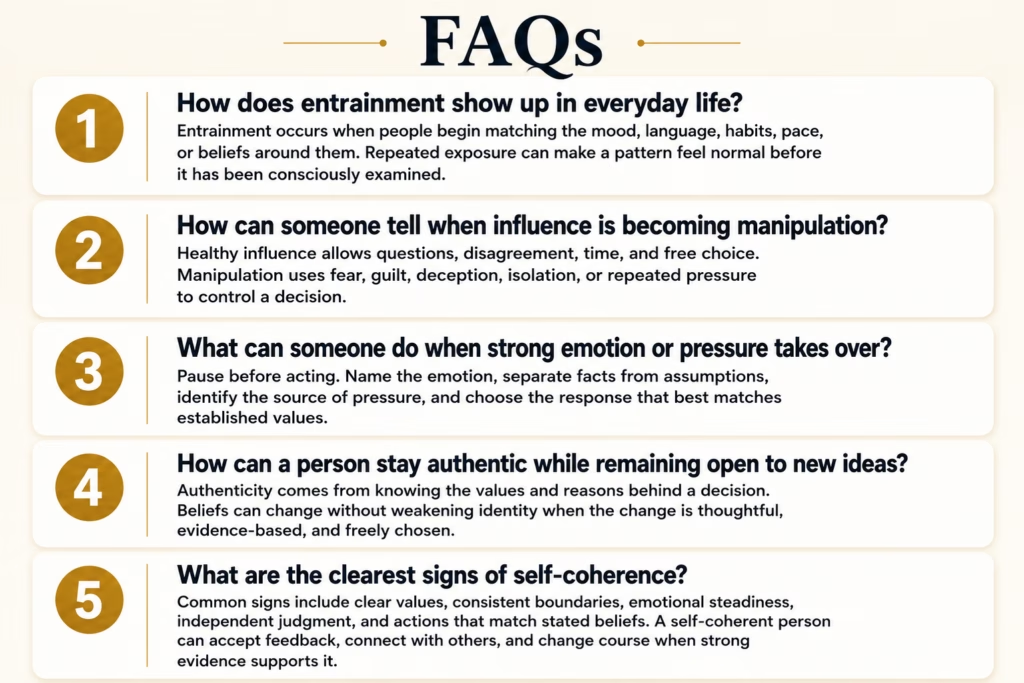
Entrainment occurs when people begin matching the mood, language, habits, pace, or beliefs around them. Repeated exposure can make a pattern feel normal before it has been consciously examined.
Healthy influence allows questions, disagreement, time, and free choice. Manipulation uses fear, guilt, deception, isolation, or repeated pressure to control a decision.
Pause before acting. Name the emotion, separate facts from assumptions, identify the source of pressure, and choose the response that best matches established values.
Authenticity comes from knowing the values and reasons behind a decision. Beliefs can change without weakening identity when the change is thoughtful, evidence-based, and freely chosen.
Common signs include clear values, consistent boundaries, emotional steadiness, independent judgment, and actions that match stated beliefs. A self-coherent person can accept feedback, connect with others, and change course when strong evidence supports it.
Conclusion
Entrainment is a basic feature of coupled systems and a useful framework for understanding human influence. People coordinate through speech, movement, attention, emotion, norms, and shared environments. That coordination can improve connection and collective action, and it can also shift judgment before the shift becomes conscious. Self-coherence gives influence a structure to meet.
A strong internal field is expressed through clear values, integrated self-knowledge, emotional regulation, consistent behavior, and relationships that tolerate differentiation. Its power lies in organized response. Incoming pressure can be noticed, interpreted, tested, and converted into action that fits both evidence and identity. Authenticity then becomes a repeatable process of alignment grounded in evidence and choice.
Practical Resources
Clarify Personal Values: The U.S. Department of Veterans Affairs provides a printable guide for identifying what matters most and using those values to guide priorities and daily decisions.
Examine Thoughts Before Reacting: The NHS Thought Record uses seven prompts to separate a situation, emotional response, assumptions, evidence, and possible alternative explanations. It supports the regulate, label, locate, reframe, and choose process described in this article.
Practice Assertive Communication: The Centre for Clinical Interventions offers a free workbook covering clear communication, saying no, handling criticism, reducing tension, and distinguishing assertiveness from passive or aggressive behavior.
Build Emotional Distress Tolerance: The free Facing Your Feelings workbook provides exercises for accepting difficult emotions, reducing impulsive reactions, solving problems, and creating a personal distress-tolerance plan.
Recognize Power and Control: The National Domestic Violence Hotline’s Power and Control Wheel helps identify patterns such as intimidation, isolation, threats, blame, and coercion. The site also connects readers with safety-planning tools and confidential support.