
Invisible disability can affect pain, energy, cognition, mobility, digestion, sensory processing, mental health, and other major life activities without creating an obvious outward sign. For women with invisible disabilities, the condition itself is often only part of the problem. Access to care, money, race, geography, communication ability, physical capacity, and whether symptoms are believed can shape what happens next.
A person may look well enough to attend an appointment, buy groceries, meet a friend, or complete a task and still be disabled. Many chronic conditions fluctuate. An activity completed on one day can trigger pain, fatigue, cognitive problems, or a flare that changes capacity the next day. Federal disability law recognizes that episodic conditions can qualify as disabilities when they substantially limit a major life activity while active.
This guide focuses on practical help: disability resources that solve specific problems, simple ways to explain a condition or set a boundary, tools for finding better medical care, and clear information about chronic illness.
In this article
- Top 5 Disability Resources
- How-To Talk about Your Disability
- Beginner’s Guide to Finding Care
- Understanding Chronic Conditions
Top 5 Disability Resources
Finding help is easier when each resource has a specific job.
1. DIAL and Centers for Independent Living: The Disability Information and Access Locator connects people with local disability-led organizations. Centers for Independent Living can help with peer support, benefits navigation, transportation, housing, assistive technology, healthcare access, and independent-living skills. This is a strong starting point when the problem involves several parts of daily life.
2. Job Accommodation Network: JAN provides free, confidential guidance on workplace accommodations and disability employment rights. Its searchable tools include ideas for fatigue, pain, migraines, mental health conditions, telework, leave, scheduling, temperature sensitivity, and other limitations.
3. Social Security Disability Starter Kit: SSA provides a checklist, worksheet, and fact sheet for disability applications. The kit helps organize medical providers, work history, treatment information, and other records before an application or interview.
4. National Disability Rights Network: NDRN connects disabled people with Protection and Advocacy agencies in every state and territory. These agencies can address disability discrimination, abuse, neglect, access problems, benefit problems, housing issues, and other legal-rights concerns.
5. 211: Local 211 services connect callers with food, housing, utility, transportation, healthcare, and other community assistance. It can be especially useful when illness has created an immediate practical problem and searching dozens of programs feels impossible.
How-To Talk about Your Disability
Talking about an invisible disability works best when the explanation stays focused on function. A diagnosis may be unfamiliar to another person. Functional language is easier to understand: symptoms fluctuate, standing is limited, concentration drops during a flare, exertion can cause delayed consequences, or an accommodation makes a task possible. Workplace disability guidance also focuses heavily on functional limitations and the changes needed to address them.
A short explanation can be enough: “Symptoms fluctuate, and capacity can change from day to day.” A workplace version can be: “This condition creates a functional limitation that requires an accommodation.” A privacy boundary can be: “That medical information is private.” A stronger boundary can be: “This disability is not open for debate.” The language used matters because words such as “lazy,” “dramatic,” and “attention-seeking” turn functional limits into character judgments.
Hostility often grows from familiar thinking patterns. Confirmation bias makes information that matches existing beliefs easier to accept. Just-world thinking can turn health and poverty into judgments about deservingness. Cognitive dissonance can make new information uncomfortable when it conflicts with a person’s identity or prior choices. Someone who can work while tired may use that experience as a reference point for every other body. Chronic pain, post-exertional illness, neurological symptoms, medication reactions, and anesthesia problems can sit far outside that personal reference point. Research has connected just-world beliefs with more negative attitudes toward disability. Related Signal Desk guides examine these mechanisms in more detail: Confirmation Bias as a Cognitive Principle and Cognitive Dissonance: Why Facts Can Fail.
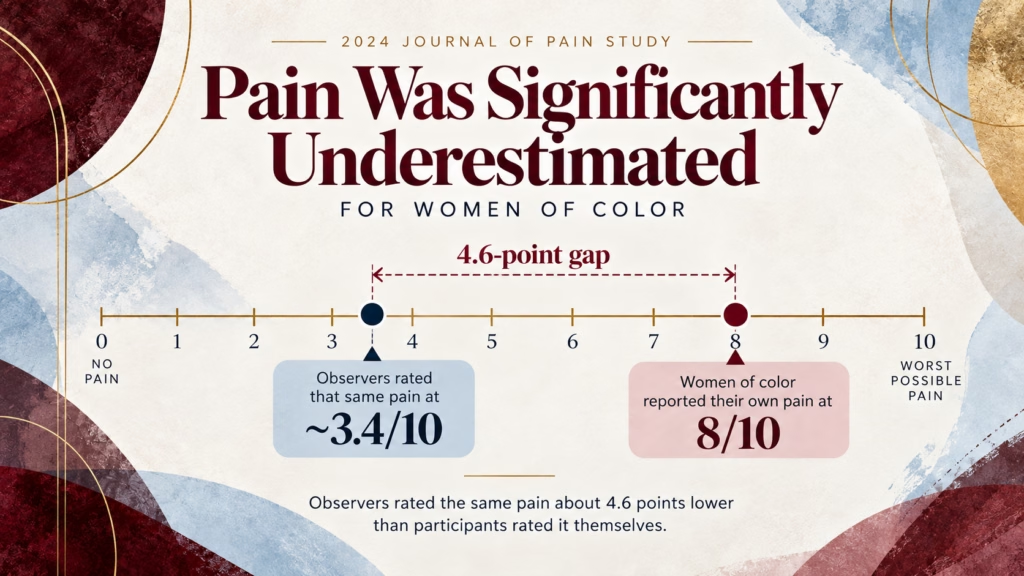
Believability is also affected by race and gender. In a 2024 Journal of Pain study, women of color’s pain was significantly underestimated. Their own pain was reported at an average of 8 out of 10, while observers rated that same pain about 4.6 points lower, effectively perceiving an 8 as roughly a 3.4.
Useful ally behavior is simple: accept reported limitations, protect privacy, ask what support is useful, avoid moral judgments about productivity, and recognize that a visible “good day” gives very little information about the rest of the week.
Beginner’s Guide to Finding Care
A strong starting point is a practitioner already educated in the condition, suspected condition, or symptom pattern. Condition-specific organizations and medical professional societies may offer clinician directories. Medicare Care Compare can help identify participating clinicians and basic credentials. A primary-care clinician can coordinate referrals when symptoms cross several specialties.
Before scheduling, a short call or portal message can screen for problems. Useful questions include: Does the clinician regularly treat this condition or symptom pattern? Which diagnostic criteria or clinical guidelines are used? How are complex or multisystem cases handled? Is the clinician comfortable coordinating with specialists? What happens when initial tests are normal and symptoms continue? Are telehealth, mobility, communication, sensory, or scheduling accommodations available?
Appointment preparation can be kept to one page. Include the main concern, when symptoms started, what makes them better or worse, current medications and supplements, allergies and reactions, major test results, previous diagnoses, and the most important questions. Add a short “function” section describing what symptoms change in daily life, such as standing, walking, driving, cooking, concentrating, sleeping, bathing, working, or recovering after exertion. NIH and AHRQ both recommend preparing questions, bringing medication information, taking notes, and using a support person when helpful.
A useful opening sentence is: “The main problem is how these symptoms are affecting daily function.” A useful closing question is: “What is the next step if this plan does not improve the problem?”
Medical records also deserve active attention. Visit notes, test results, imaging, medication trials, adverse reactions, referrals, and clinician instructions can be saved in one folder. Inaccurate chart information can be addressed through a formal amendment request. A second opinion is reasonable when symptoms remain unexplained, treatment is failing, communication has broken down, or the clinical picture falls outside a provider’s expertise.
Understanding Chronic Conditions
Invisible disability often requires a model of capacity. Ability can change across hours or days. Completing an activity can consume the capacity needed for the rest of the day or create delayed consequences. The ADA specifically recognizes episodic conditions when they substantially limit a major life activity while active.
Diagnosis can also be complicated by fragmented care. Symptoms may cross specialties, tests may capture only one moment, and mental health diagnoses can coexist with physical disease. Pain, isolation, uncertainty, financial pressure, and repeated dismissal can also affect mental health. Good care keeps the full picture open and continues to reassess when the evidence changes. Rising diagnosis counts can also reflect better recognition, screening, and updated criteria.
Access is uneven. Rural location can limit specialists. Money and insurance can limit testing and follow-up. Communication barriers can affect the history recorded in a chart. Race and gender can affect pain assessment. Physical capacity can determine whether repeated appointments are even possible. Healthcare civil-rights rules require covered organizations to provide effective communication and appropriate auxiliary aids when needed.
Social Security disability programs also require careful language. SSA describes Social Security disability benefits as an earned right tied to covered work and payroll contributions. SSDI eligibility also depends on work credits. SSI is a separate means-tested program that does not require the same work history. Applications move through several levels of review, and later decisions can consider additional evidence. For disabled-worker claims filed from 2014 through 2023, the Social Security Administration reported an average final award rate of only 29 percent.
Resources
- ADA definition of disability: ADA.gov disability definition
- Disability Information and Access Locator: DIAL local resource finder
- Job Accommodation Network: JAN accommodation resources
- Adult Disability Starter Kit: Social Security Disability Starter Kit
- Find a Protection and Advocacy agency: National Disability Rights Network
FAQs
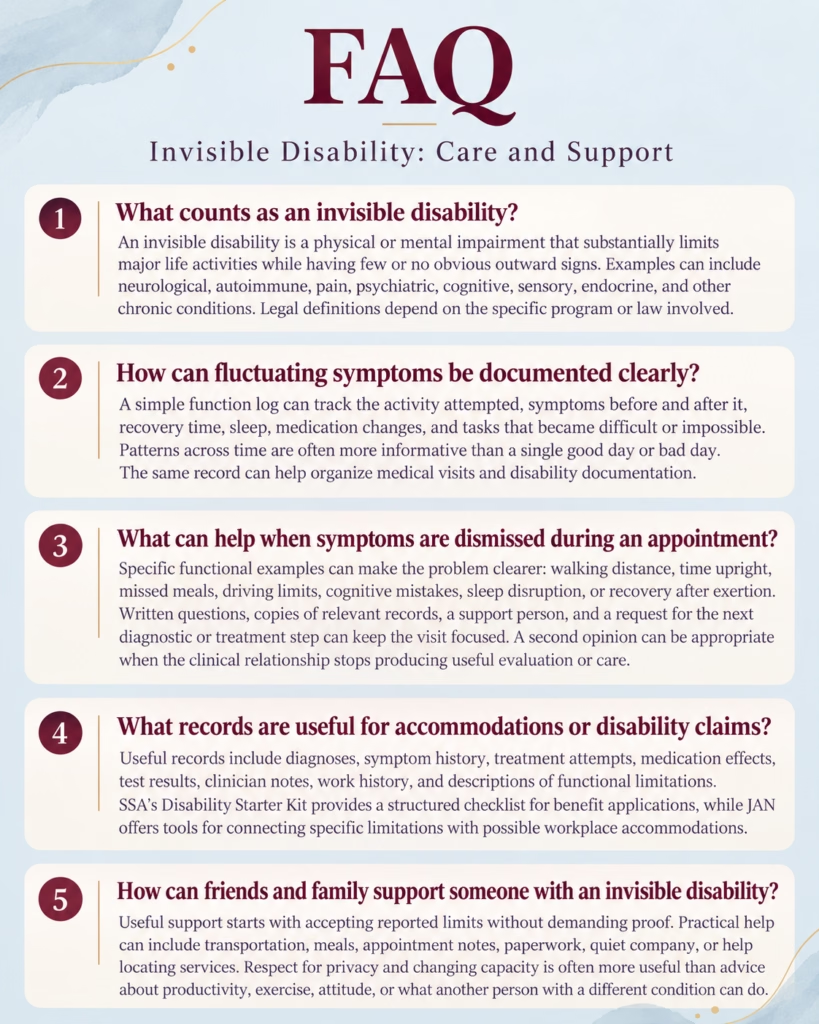
An invisible disability is a physical or mental impairment that substantially limits major life activities while having few or no obvious outward signs. Examples can include neurological, autoimmune, pain, psychiatric, cognitive, sensory, endocrine, and other chronic conditions. Legal definitions depend on the specific program or law involved.
A simple function log can track the activity attempted, symptoms before and after it, recovery time, sleep, medication changes, and tasks that became difficult or impossible. Patterns across time are often more informative than a single good day or bad day. The same record can help organize medical visits and disability documentation.
Specific functional examples can make the problem clearer: walking distance, time upright, missed meals, driving limits, cognitive mistakes, sleep disruption, or recovery after exertion. Written questions, copies of relevant records, a support person, and a request for the next diagnostic or treatment step can keep the visit focused. A second opinion can be appropriate when the clinical relationship stops producing useful evaluation or care.
Useful records include diagnoses, symptom history, treatment attempts, medication effects, test results, clinician notes, work history, and descriptions of functional limitations. SSA’s Disability Starter Kit provides a structured checklist for benefit applications, while JAN offers tools for connecting specific limitations with possible workplace accommodations.
Useful support starts with accepting reported limits without demanding proof. Practical help can include transportation, meals, appointment notes, paperwork, quiet company, or help locating services. Respect for privacy and changing capacity is often more useful than advice about productivity, exercise, attitude, or what another person with a different condition can do.
Conclusion
Invisible disability can be difficult to explain because the evidence often lives in symptoms, patterns, medical records, and consequences that other people cannot see. A person can appear functional during one small window of time and still live with severe limitations before or after that moment.
Useful support comes from making the invisible easier to document and navigate. Clear functional language, a one-page symptom record, condition-informed care, accurate benefit information, legal-rights resources, and disability-led community support can reduce some of the burden of having to repeatedly prove that a chronic condition is real.
Conclusion CTA
A practical next step is to create a one-page symptom and function summary, bookmark DIAL and JAN, and use the Social Security Disability Starter Kit or a local Protection and Advocacy agency when benefits or legal-rights questions arise.